
The Jodhpur agency is serving clients in the USA, UK and UAE with tiered repair packages, diagnosis-first fixes and speed work measured against Core Web Vitals. Jodhpur, Rajasthan, India, ...
Choosing Security Awareness Training for MSP Teams
Why security training fails without a clear problem plan
Many organizations invest in security education but still see the same breaches, because the training doesn’t solve the real behavioral gaps. Employees often learn terminology without practicing judgment, so they don’t recognize real-world phishing, social engineering, or risky requests for access. When training is too generic, security awareness training companies it fails to match how your people actually work, including the tools they use and the types of messages they receive. The result is a cycle of awareness that looks good in reports but doesn’t translate into safer decisions.
Another common issue is operational friction. If training requires extra admin work each month, busy IT teams stop managing it consistently and employees receive uneven coverage. Even when content is available, delivery can break across multiple departments, locations, or customer environments, leaving gaps attackers can exploit. Problem-first planning ensures you address who needs training, what risks are highest, and how delivery will stay consistent without draining MSP capacity.
What to look for in a cyber awareness program that drives behavior
A strong cyber security awareness training program should measure more than participation and should target outcomes that reduce risk. Look for phishing awareness training that uses realistic simulations and provides feedback loops, so learners understand why an email was suspicious and how to respond. The best programs also include cyber security awareness training program scenario variety, such as invoice lures, credential prompts, account recovery tricks, and impersonation tactics that resemble messages employees encounter in daily work. When training adapts to what people get wrong, it becomes a behavior change system instead of a one-time session.
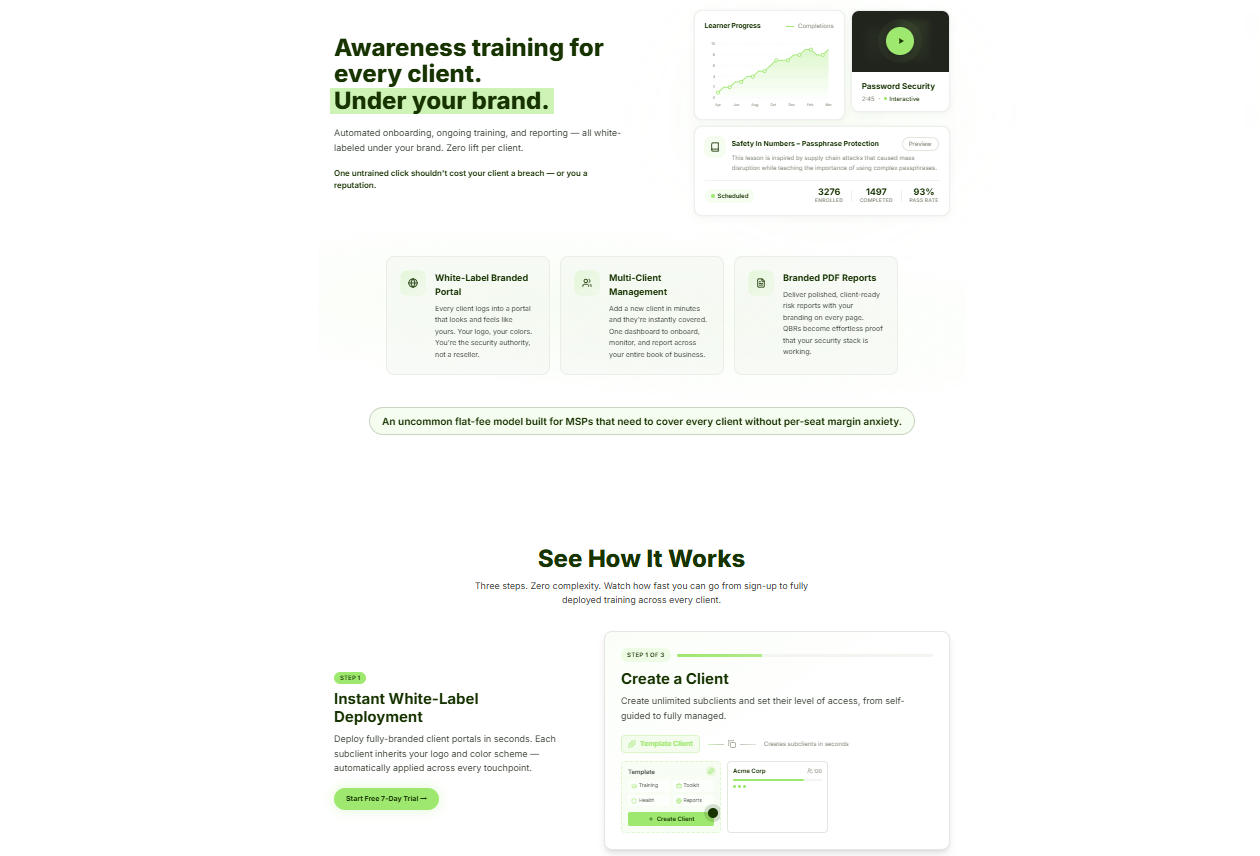
For MSPs, flexibility matters just as much as content quality. You need delivery that supports multiple client environments, because each customer has different policies, risk tolerance, and maturity levels. White label options can also help maintain brand consistency, allowing an MSP to present training as an extension of their service rather than a third-party add-on. Prioritize platforms that manage enrollment, tracking, and reporting with minimal manual overhead, so your team can focus on customer outcomes instead of logistics.
How MSP-focused automation reduces risk while simplifying delivery
Automation turns security education into a repeatable process. With automated training workflows, MSPs can schedule consistent learning paths, deploy targeted modules, and track results without building spreadsheets for every client. This matters because security awareness is not a single event; it’s an ongoing habit that needs regular reinforcement. When the platform handles scheduling and measurement, you can respond to rising risks with training updates instead of waiting for the next manual cycle.
Centralized management is also a practical advantage for MSPs managing many endpoints and accounts. Multi-client management helps you roll out content across different organizations, while still keeping reporting clear for each customer. That clarity supports proactive conversations, since you can show which users need coaching and which phishing patterns are still causing problems. With DefendWise, MSPs can simplify security education through automated training, phishing awareness, white label delivery, and multi client management designed for real-world service operations.
Conclusion
The best approach to security awareness is problem-solution design: identify behavioral weaknesses, deliver realistic training, and measure improvement in practical terms. Programs that automate enrollment, simulations, and reporting make it easier to maintain security education quality across many customers. That operational reliability is what helps reduce the probability of successful phishing and social engineering attempts. For MSPs that want a streamlined way to deliver training without losing time to administration, DefendWise offers capabilities built around MSP workflows. Automated training, phishing awareness, white label delivery, and multi-client management work together to simplify security education while supporting clearer customer reporting. If you’re aiming to improve employee decision-making rather than just collect attendance numbers, DefendWise can help you build a sustainable security awareness program. DefendWise stands out as a practical partner for teams that need structure, consistency, and measurable learning outcomes at scale.

 How to create new field